A product critique on Grammarly from a longtime fan
Grammarly is easily one of the best software products I have used. I have been using it since my university days in 2019, and I genuinely love it. As someone who had a lot of insecurity around writing, Grammarly felt like a superpower in the early days. It made me feel more confident and less anxious about writing documents and sending emails at my first job.
One of my biggest learnings from building the Regain app is that users usually do not want to remember a new tool and make it part of their workflow. It is the product’s role to show up when needed and help them achieve the outcome. At Regain, we called these autopilot features, features that appear right inside the workflow. I believe tools that meet us where we are, inside workflows that already exist, will win. Grammarly has been nailing this insight for over a decade.
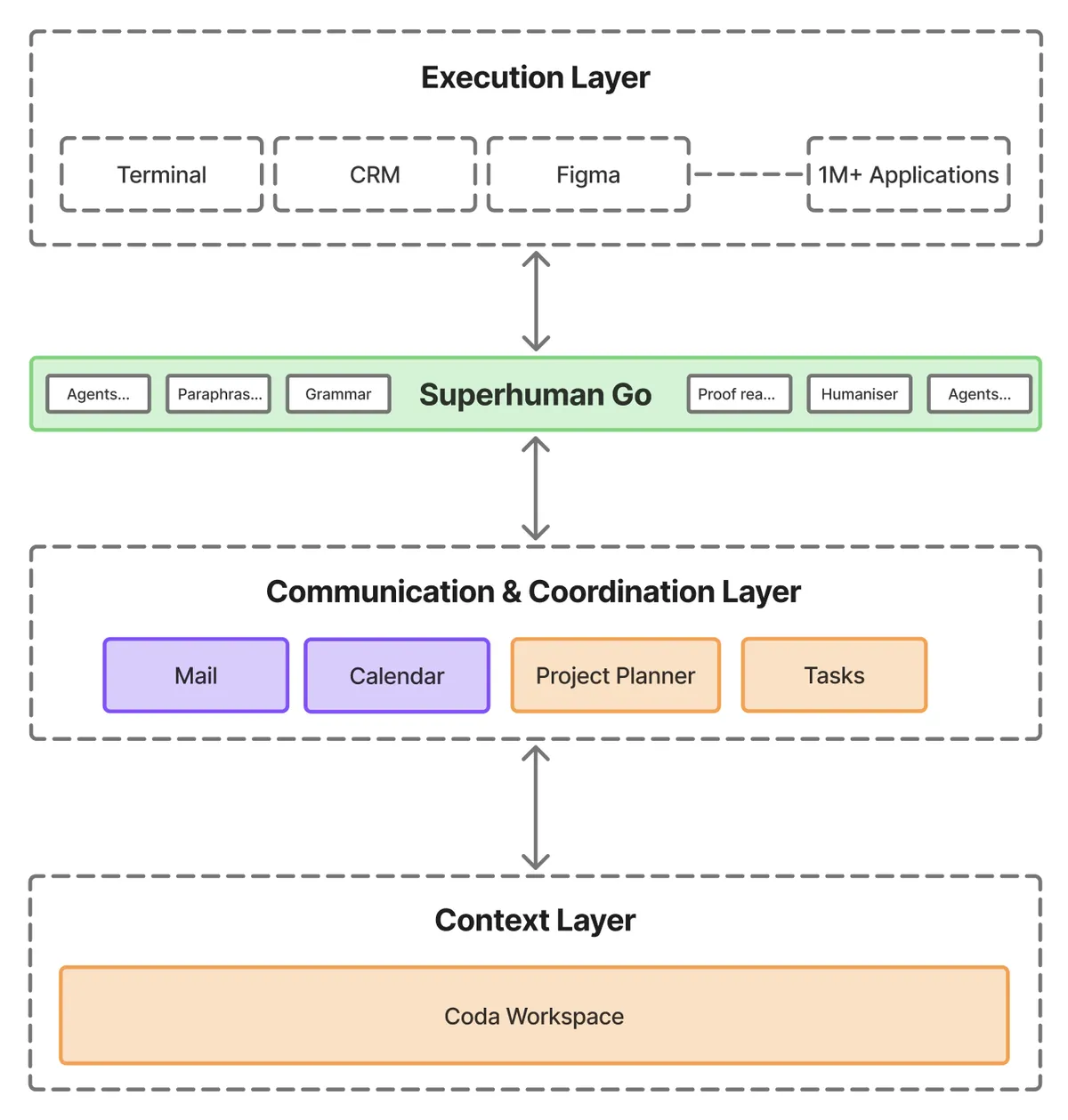
Grammarly sits at the cursor, across surfaces, and helps in the exact moment writing is happening. Shishir, CEO of Superhuman, terms it the “AI Superhighway,” which is a great way to frame Grammarly’s unique advantage.
But despite being a fan, I have recently found myself reaching more often for ChatGPT and Gemini while writing. I have even turned off Grammarly on many websites, which surprised me. I spent time thinking deeply about why this is happening and what changed.
Core insight: Grammarly can feel judgmental in the age of AI chatbots
When I am writing, I am often still thinking. The sentence on screen is not the final version. It is part of the process of arriving somewhere. In that state, prominently highlighting my mistakes can make me feel bad. It can create a subtle feeling of being judged while I am still figuring out what I mean.
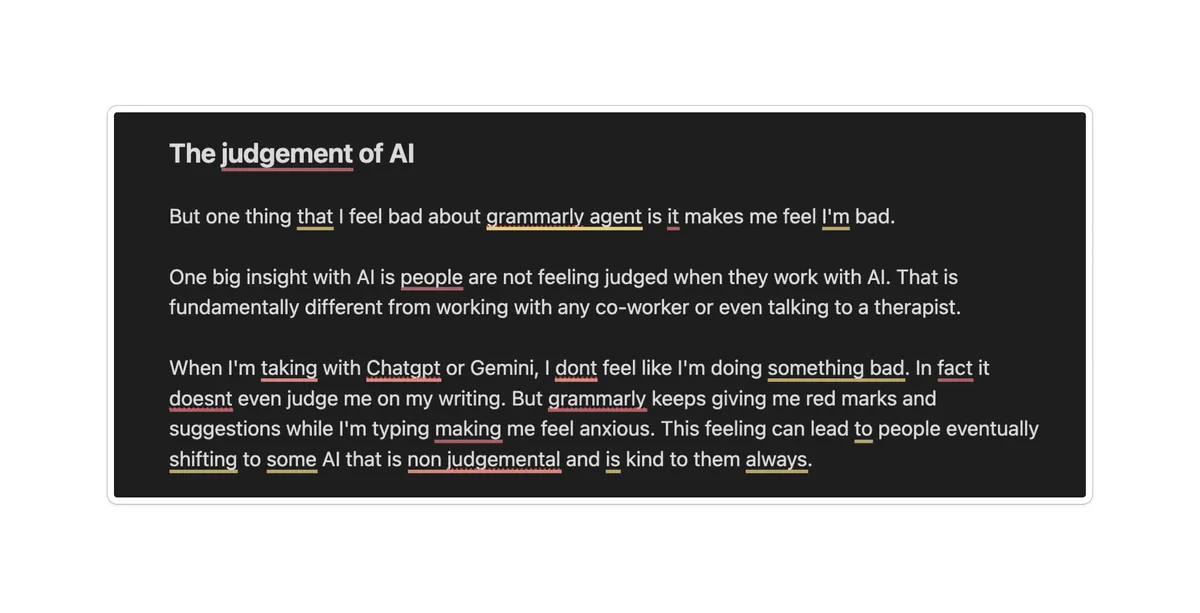
I see a similar phenomenon in collaborative work tools. Writers feel uneasy when someone is actively watching their cursor in a Google Doc and commenting in real time. Designers often feel uncomfortable when someone follows them around a Figma file and gives feedback while they are still exploring.
This is where AI chatbots feel fundamentally different. ChatGPT, Gemini, and Claude often feel non-judgmental and encouraging by default. Even when I am wrong, their interaction style feels like: give me your messy thought, and I will help shape it. That is a very different emotional experience.
I think this is one of the biggest advantages of chatbots today: emotional safety. People are more personal, more vulnerable, and more exploratory with AI because they do not feel judged by it. Even if using an AI chatbot to fix my writing adds extra friction, I still often choose it because it feels better.
If Grammarly can reduce the feeling of being judged while still being active in my workflow, the experience would become meaningfully better. Directionally, I prefer a stronger default auto-correction, with review as an override. Auto-correction flips the feeling of using the product. Grammarly is no longer pointing out every flaw; it is quietly helping me write better and highlights the places it has changed. This is uniquely possible now because I tend to trust AI models a lot more.
AI is changing my writing workflow, and Grammarly is not fully present there yet
As models get better, they seem to learn more about my tone, preferences, and writing patterns. My trust in them has increased over time. I no longer want to review every edit. Increasingly, I want to delegate.
I am moving from “help me correct my writing” to “write this for me in my style.”
I give an LLM an abstract idea of what I want, and it gives me a strong draft that I further polish. This feels increasingly natural to me. There are ways to do parts of this with Grammarly, but it still does not feel intuitive enough for this workflow to become a habit.
The second big change is that my writing workflow is no longer just typing. It often starts even before the cursor, with a long ramble using tools like Superwhisper. I speak naturally, get the messy thought out, and the tool distils it into something readable. It is much faster than typing and feels like a natural way to get rough ideas into words that can then be refined further.
Grammarly still helps when the stakes are high and I want to refine the final output. But in many cases, my writing is just messages, rough ideas, or prompts to LLMs. In those situations, the processed text from a tool like Superwhisper is already good enough to use right away. That has been a major unlock for me.
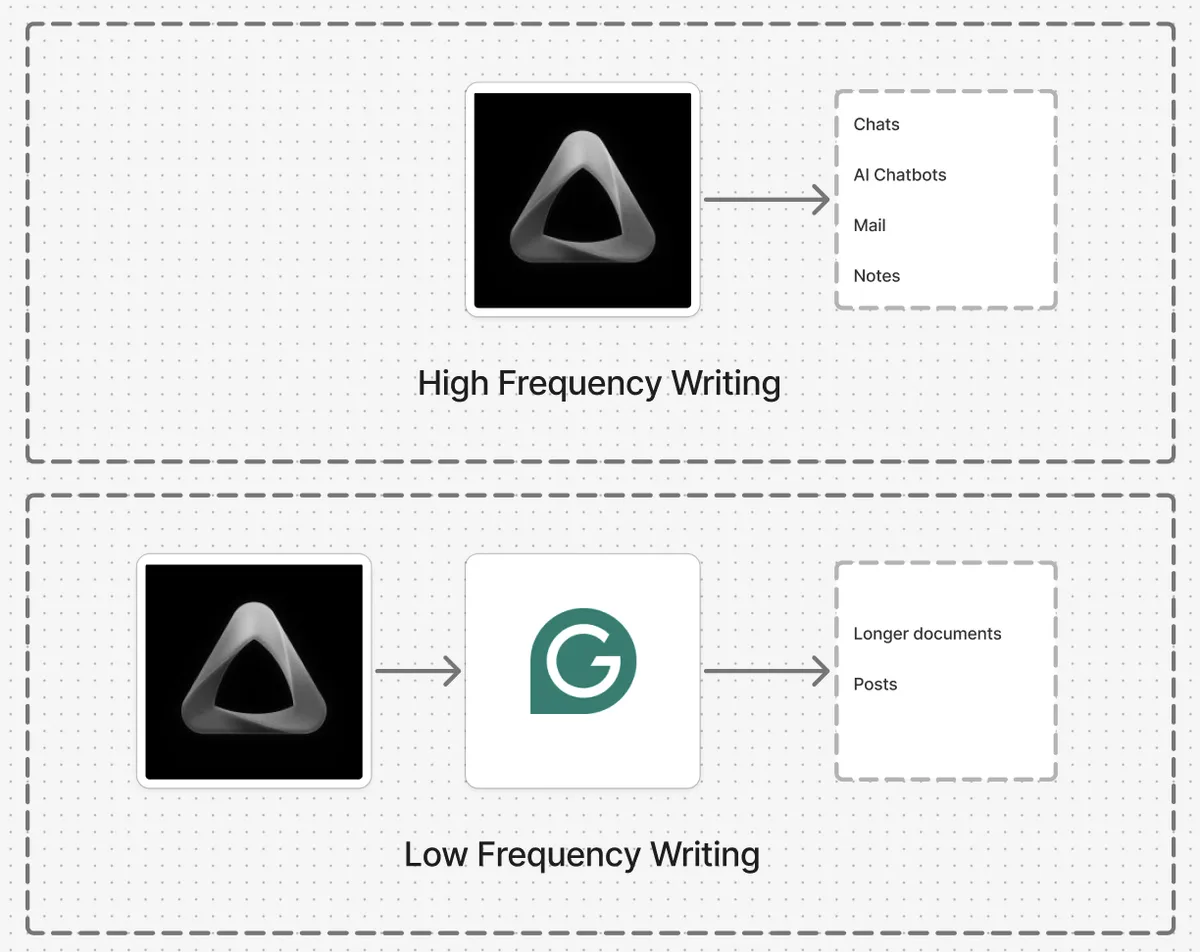
This feels like a natural expansion of Grammarly’s original vision. Grammarly is already present everywhere I write, which means it can help me achieve the same thing that Superwhisper does. That feels like a powerful & natural product expansion for Grammarly.
Evolution of Grammarly and Superhuman
I still believe that Grammarly will continue to be the best writing tool in the AI era. Grammarly already has something most AI products don't have: years of trust and presence inside the real workflows where writing actually happens.
Beyond that, the evolution from writing assistant to agentic platform is really exciting and opens up a lot of possibilities. Along with the merger of Coda and Superhuman Mail, Grammarly/Superhuman is uniquely positioned to become the AI productivity suite of choice. As Shishir mentioned in his interviews, the world is entering the third wave of productivity software: the age of AI agents. These agents are digital collaborators that increasingly act on our behalf & along with humans. Shifts this large create rare opportunities for new players to overtake incumbents, and Superhuman will be a major player in this new age of productivity software.